ASUS ROG Zephyrus G16 2026 vs 2025 — Choose Wisely
$4,800. That is exactly what this laptop costs. And honestly, I almost didn't make this video because the conclusion felt too easy. But then I ran the benchmarks, and one number came back so much better than last year's model that I had to talk about it. It's probably not the number you're thinking of — and no, it still doesn't mean most of you should buy this thing at this price. There's one specific thing most of you should do instead.
Quick Verdict
The 2026 Zephyrus G16 is a solid generational step — meaningfully better battery life, a much brighter display, a quieter chassis, and better multi-core performance than last year's model. But it is not a massive upgrade, and ASUS is charging $1,300 more for it ($4,800 for the 64GB model vs. roughly $3,500 for last year's 32GB model). Unless you specifically need the new chip or the display, the smarter move is to buy up last year's G16 inventory while it's still available — prices are only going up from here.
Design: Nearly Identical
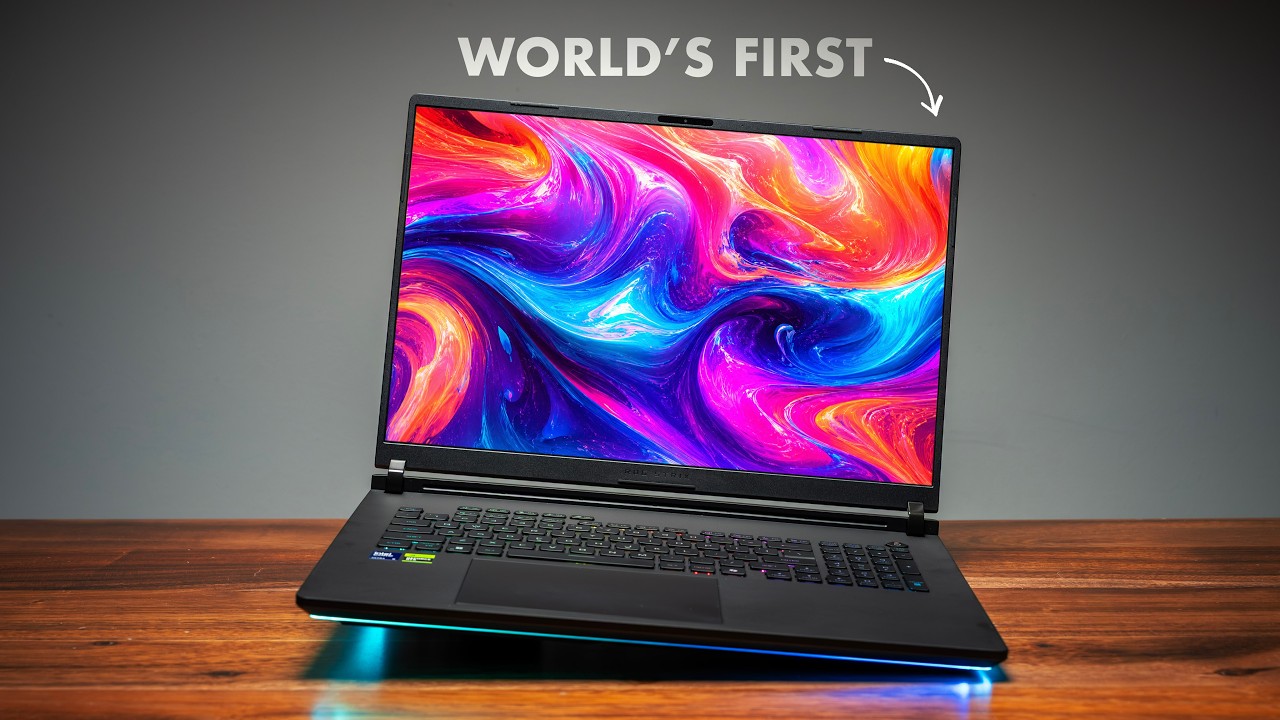
From a design standpoint, the 2026 G16 is pretty much the exact same laptop as last year. Still about 4.3 lb, still an all-metal chassis, still the same port layout: on the left, power connector, HDMI 2.1, USB-A, and Thunderbolt 4 (not 5 — I would have loved to see Thunderbolt 5 here) plus a combo audio jack. On the right, a USB-C port (not Thunderbolt), USB-A, and a full-size SD card slot running UHS-II at 312MB/s.
The one change you'll notice — if you're looking for it — is the Slash Lighting on the lid. The 2025 had visible slits; the 2026 is more of a mirrored reflection, cleaner-looking, no visible cuts. Still available in silver, still picks up fingerprints and gets a bit smudgy, but still a gorgeous laptop.
The keyboard layout is unchanged but cleaner — the caps lock key just says "Caps" now instead of being fully spelled out, the Enter key wording is gone, arrow keys are just arrows. It's a small, subtle refresh across the board. Typing feel is still excellent, great travel distance, one-zone RGB backlighting (which I'm fine with — I'm past the per-key RGB phase of my life).
The touchpad is still massive but not haptic, which at this price point companies really should start addressing. And the ASUS sticker on the deck is still slightly crooked — better than last year, but not perfect.
Display: The First Big Upgrade
This is where the first real change hits you. Still a 16-inch, 16:10, 240Hz panel with a fast response time — everything feels instant. But this year ASUS pushed peak brightness to 1,000 nits, and HDR content finally looks like HDR content. Working outdoors is a noticeably better experience than on the 2025 panel. Still no touch, still no fingerprint scanner — you're using Windows Hello facial recognition to log in, and it works well.
A Quieter Laptop
The thing I noticed right away is that the new G16 is simply a quieter experience. On the performance and silent profiles, fans run lower than the previous model. It still gets loud in Turbo — about 55dB — and manual mode lets you crank the fans further if you want, but the speakers do a good job of drowning that out. It just takes a lot more to get there than it did last year.
Performance: The Twist Isn't Where You'd Expect
The unit tested here comes with an RTX 5080 and 64GB of RAM — and RAM today is basically more valuable than gold, which is a big part of why this configuration costs what it does: $4,800 US for 64GB and a 1TB NVMe SSD. There's also a 5070 Ti model with 32GB of RAM in the US; in Canada, ASUS actually offers a much wider spread this year, from RTX 5060 all the way up to RTX 5090.
Inside is Intel's Core Ultra 9 386H (Panther Lake), replacing last year's Arrow Lake 285H.
- Single-core: clearly higher than last year, not touching the MacBook Pro 16, but better than before and right in line with other 386H laptops.
- Multi-core: a big jump over last year — genuinely edges out some serious competition, though still a fraction of the MacBook Pro 16.
- Browser workloads: slightly slower than some other 386H machines I've tested, for reasons I can't fully explain, but it still handles any modern application fine, and it did well in Firefox.
- Compile test: just under 30 minutes — not the fastest I've run, but fast enough.
- Photoshop: performs great, though not the fastest laptop on the market — anything with unified memory will beat it.
- Gaming: at 135 watts in a chassis this thin, the RTX 5080 does well, though it's not full RTX 5080 performance like you'd see in a bigger 175-watt chassis. Comfortable 2560×1600 gaming across the board; drop to 1920×1200 if you want to chase 240 FPS.
The catch: temperatures actually run hotter than the previous model — into the higher 80s°C, where the old one sat in the lower 80s, even with a new drilled bottom panel. Funny enough, that's the opposite of what happened with the G14, where the new Panther Lake chip needed less power. Here you get slightly higher average clock speeds and a slightly hotter chip, but it's more efficient overall.
Battery: The Real Headline
Last year's G16 gave me 9 hours in PCMark's Modern Office test. This one hit 13 hours and 46 minutes — almost 5 extra hours on the same class of hardware. Honestly, this is the biggest real-world upgrade on this machine, and it's not something that shows up on the spec sheet.
Internals
Vapor chamber cooler, an NVMe SSD with a second open slot for expansion, an upgradeable Wi-Fi 7 card (an upgrade over last year), and a 90Wh battery. RAM isn't upgradeable, as usual, but the Wi-Fi card and storage are.
The Bottom Line
Here's the same conclusion I landed on with the G14 video: this is a solid laptop. It's better than its predecessor thanks to the 386H, and better than the HX 370 you'll find in most other gaming laptops right now. But it is not a massive upgrade — and the pricing is genuinely rough. $4,800 for the 64GB model when last year's 32GB model was around $3,500 is an extra $1,300. In today's economy, I can't tell you that's worth it unless you specifically need it and have the money to spend. Even the 5070 Ti version comes in at $3,700 — you're paying more for a worse GPU than last year's 5080.
So here's what most of you should actually do: buy up last year's inventory while you still can. Every month that passes, these laptops get more expensive because of RAM and SSD pricing, and that trend isn't reversing anytime soon. If you need a laptop today, buy it today — don't wait. If a real deal on the 2026 model ever shows up, which I don't expect for a long time, grab it. But right now, the old stock is the smarter buy for most people.
Who Should Buy Which?
Buy the 2026 ASUS Zephyrus G16 if:
- You want the brightest possible display and true HDR
- You want the quietest fan profile ASUS has shipped on this chassis
- You need the extra battery life for genuinely mobile use
- You want the widest GPU selection (Canada) or are set on the newest chip regardless of price
Buy the 2025 ASUS Zephyrus G16 if:
- You can find it in stock at a real discount
- The $1,300 price gap doesn't map to features you'll actually use
- You want a proven, nearly-identical laptop for meaningfully less money
Where to Buy
Affiliate Disclosure: This article contains affiliate links. If you purchase through these links, we may earn a commission at no extra cost to you.
Published: July 2026